


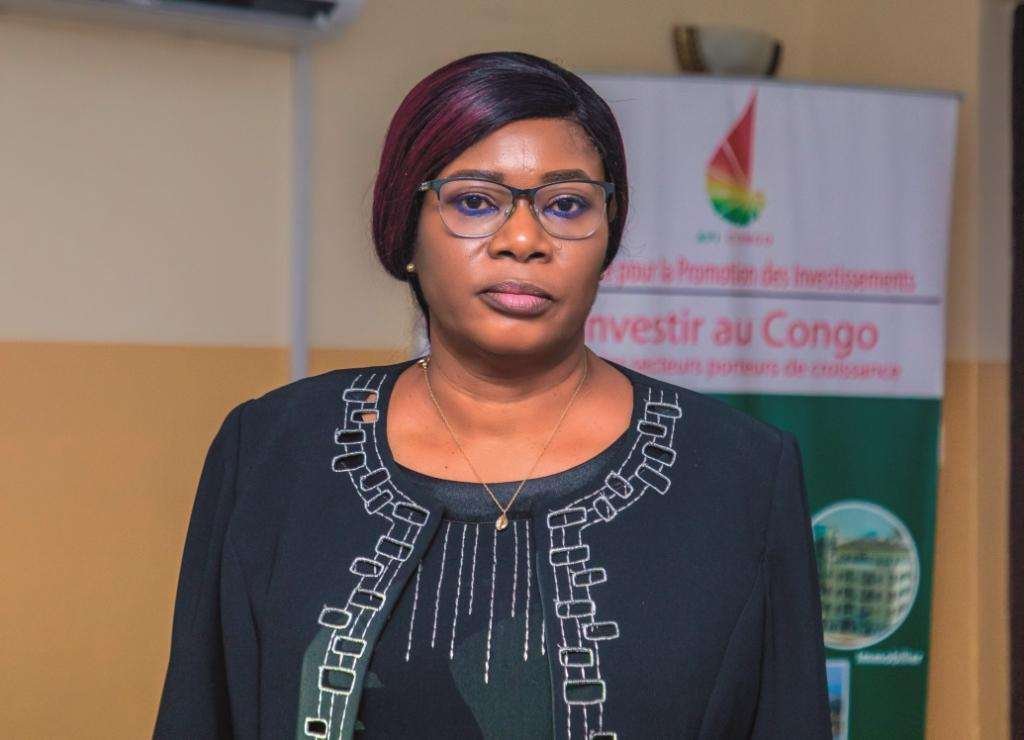
Interview with Annick Patricia Mongo, Special Advisor to the Prime Minister and Director General of the Investment Promotion Agency (API-Congo). This experienced lawyer contributed to making the Republic of Congo the leading destination for direct investment in Central Africa.
In the National Development Plan (NDP) 2022-2026, what are the priority economic sectors for investment?
The National Development Plan (PND 2022-2026) is the implementation of the societal program of His Excellency Mr. President of the Republic Denis Sassou Nguesso, "Together, let us continue the march" which places economic diversification and the objectives of sustainable, resilient and inclusive economic growth at the heart of its concerns.
It is in this capacity that, from the point of view of API-Congo, in connection with our mission, as prescribed by Law 19-2012 of August 22, 2012, which includes the promotion of Congo as an investment destination and the facilitation of private investments with a view to increasing investment in all sectors of economic activity, the priority sectors for investment fall under the main strategic priority axes adopted by the PND 2022-2026 and also the cross-cutting areas which support the development of these strategic sectors.
From this point of view, we generally encourage and support investors who direct their investment decisions towards Agriculture in the broadest sense, industry, tourism, digital technology, Special Economic Zones, Real Estate, basic infrastructure and more generally cross-cutting sectors of activity which contribute to the achievement of the objectives of the 2022-2026 National Development Plan such as energy and other basic infrastructure.
What is the role of the private sector in the implementation of the 2022-2026 National Development Plan?
Given the socio-economic objectives pursued by the 2022-2026 National Development Plan, the private sector is called upon to play a leading role in the implementation of this plan.
Indeed, the State has high expectations of the private sector, which has been involved to some extent in the development of this plan and has been repeatedly made aware of the expected private sector participation in the implementation of the National Development Plan (NDP). Obviously, the private sector is not expected to invest without expecting a return on its investments at the State's discretion. That would be nonsensical, as the private sector is meant to expect a return on its investments. Therefore, the State's objective is to create the conditions to encourage private sector participation in the anticipated investments in the priority sectors of the 2022-2026 NDP, and the private sector's objective is to seize the opportunities presented by the mature projects of the 2022-2026 NDP. Private sector participation is expected to reach up to 701,300,000 TND in financing NDP projects, including investments in the form of Public-Private Partnerships.
The importance of the role of the private sector in achieving the objectives of the NDP can be summarized in the statement of the Prime Minister, Head of Government, who said in one of his speeches that "the Government will be judged by its ability to mobilize private investors for investment in the sectors of the NDP 2022-2026".
The relevant bodies of the AfCFTA have finalized the legal review of the three main AfCFTA protocols, including the investment protocol. What will this protocol bring to Congo in terms of FDI?
The Congo is a State Party to the African Continental Free Trade Area (AfCFTA) agreement, which it signed on March 18, 2018, ratified on December 27, 2018, and the law promulgated on February 7, 2019. Since then, the Government has been working to raise awareness among economic actors about the issues of the AfCFTA through the dissemination of the national strategy for the implementation of the AfCFTA.
The provisions of this investment protocol, in which API-Congo was involved in the negotiation on behalf of Congo, are designed to encourage intra-African investment and trade, but also to make Africa a destination for investment both for investors outside Africa and for African investors to invest in other countries of the continent.
A number of investment provisions are now common across the continent.
The integration of the concept of sustainable development into this protocol is now a shared vision. This means that the States Parties agree to facilitate, as best as possible, investments that take into account and reconcile the concerns of countries regarding their economic and social development and the protection of the environment.
Another innovation: the establishment of a Pan-African Agency for Trade and Investment Promotion intended to give new impetus to the National Investment Promotion Agencies of the AfCFTA member countries, and create the conditions for attracting and increasing sustainable intra-African investments.
Congo, which already has a tradition of attracting foreign investment, particularly in the oil sector, intends to redouble its efforts and optimize the necessary reforms to align with best practices in attracting and retaining investment in order to position the country among the preferred destinations for investors and investments from all backgrounds, including in non-oil sectors, conducive to deepening the diversification of the national economy.
You are now Special Advisor to the Prime Minister. What does your mission at the Prime Minister's Office consist of?
Indeed, I enjoy the confidence of the Prime Minister, Head of Government, who has kindly appointed me Special Advisor, in charge of Investment Promotion and the improvement of the Business Climate.
My mission is to assist the Prime Minister, Head of Government, in taking the appropriate measures to meet the needs of our private sector in terms of improving the business climate.
I must say that it is an exciting but very demanding and arduous task in terms of the expected results. Because, as you know, the business climate in particular is everyone's business and the issue is cross-cutting.
Reforms and texts are being developed, but if everyone, wherever they are, in the business sphere and in administration and generally in the investment environment, does not participate in the effective application of the texts adopted and the effective implementation of the reforms undertaken, all our efforts will be in vain, and it is precisely at this level that the task is difficult.
My mission at the Prime Minister's office therefore includes an important part of raising awareness among stakeholders about the business climate and the investment environment, highlighting the importance and urgency of recognizing the issues inherent in the business climate and the promotion of investments, and therefore in marketing our country as a hotbed of opportunities just waiting to be exploited and as a destination for investments in all directions.
Among other things, the underlying issue is the need to foster and continuously cultivate public-investor dialogue through all available means, in order to bring public administrations and investors closer together and maintain ongoing consultation, thereby creating the conditions for the continuous improvement of the business climate and the attractiveness of our country. Only in this way can Congo effectively adapt to international developments, by developing enhanced capacities to attract and retain useful and innovative investments that support the desired economic diversification.
This is what we are working towards, and it is with this vision in mind that the first edition of the "Investors' Breakfast" was organized on February 25, 2023. This event brought together investors and companies incorporated under Congolese law with the Prime Minister and some members of the Government for a direct and frank dialogue that was well received by the businesses. This event, the first of its kind, allowed investors established in Congo to express their grievances frankly and directly to the government, and it also led to resolutions designed to significantly improve the business climate and the investment environment in several areas.
Furthermore, the Prime Minister, Head of Government, has issued several circulars to public administrations in order to prohibit certain behaviors criticized by the private sector.
Eight women are currently members of the government out of 37 ministers. Is the role of women in Congo more prominent in the business world?
To date, we have approximately 201 women in government. This isn't so bad, even if we're still below the target of 301 women in decision-making positions. Many large, so-called developed countries have a lower rate than Congo.
I would also like to take this opportunity, given the reason for your question, to highlight a fact that is not often mentioned but which is to our country's advantage: gender equality in pay. It's not said often enough, but we are one of the countries that stands out because men and women, with equal qualifications, earn the same salary. The question of gender doesn't even arise when it comes to the remuneration of employees or managers. As you well know, this is not the case in many countries, including some developed ones.
As for the role of women in the business world, it is very important, and there are many women in business in Congo. And if we were to add the social dimension to these businesses, I would even say that women are the foundation of the businesses that truly sustain the population in Congo, because they are the ones who run the very small and small enterprises, both in the informal and formal sectors of the craft industry, which provide employment, including self-employment. Everyone knows how much these sectors of activity form the basis and the crucible of the very small and small and medium-sized enterprises (SMEs) that constitute the bulk of the Congolese economy. Considering only the formal sector, according to statistics from the Congolese Agency for Business Creation (ACPCE), on average, between 2015 and 2021, 261,000 businesses were created by women.
The Congo therefore has significant potential in women entrepreneurs and it is no coincidence that the 12th edition of the International Forum of Women Entrepreneurs (FIED), bringing together more than twenty (20) countries under the theme "Let's support African businesses to strengthen the capacities of processing sectors, accelerating 'Made in Africa'", was held in Congo, in Brazzaville, from July 31 to August 5, 2023, under the high authority and patronage of Mrs. Antoinette Sassou Nguesso, wife of the Head of State.