


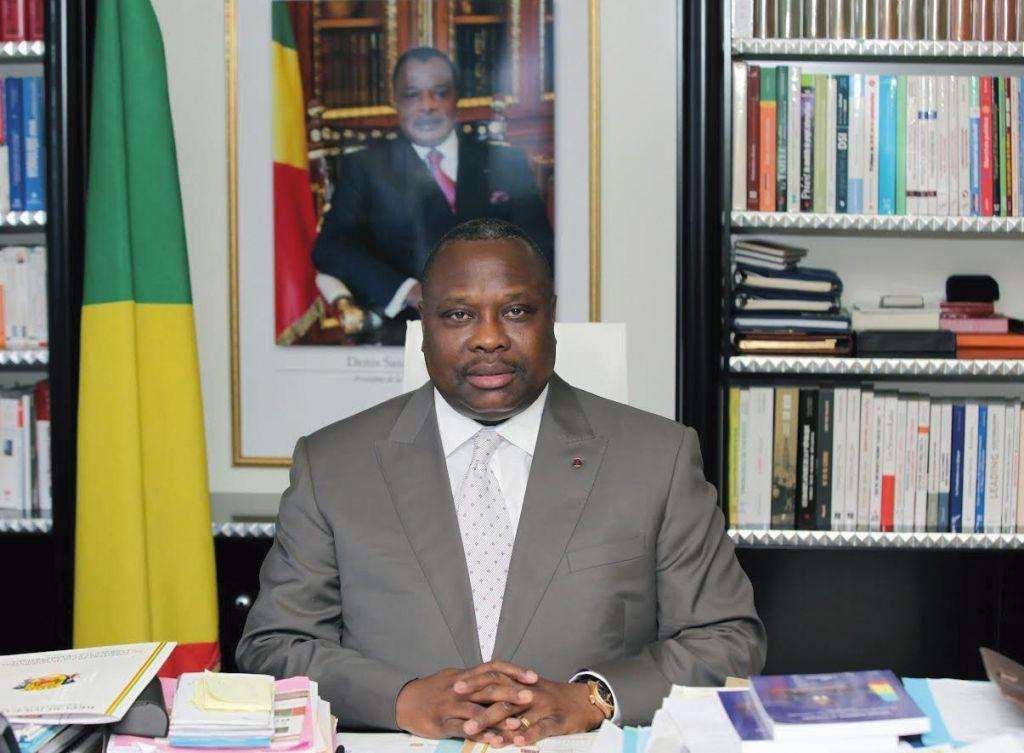
Interview with Jean-Jacques Bouya, Minister of State, Minister of Territorial Development, Infrastructure and Road Maintenance since May 15, 2021. He previously held the following positions: Advisor on Transport and Equipment to the Head of State, General Delegate for Major Works, Minister at the Presidency of the Republic, in charge of Territorial Development and the General Delegation for Major Works, and Minister of Territorial Development, Equipment and Major Works.
Regarding road maintenance and bridge construction, what projects are currently underway?
At the outset, I would like to express my gratitude for this opportunity to discuss matters directly related to my ministry. The Government of the Republic has always prioritized infrastructure development to create conditions conducive to inclusive economic diversification and the modernization of the country. The availability of efficient economic infrastructure is a prerequisite for the success of any initiative aimed at improving living conditions and reducing poverty. It was in this context that the World Bank emphasized in 1994 that "infrastructure is the engine of economic activity, and its deficiency in poor countries delays their economic takeoff." This is why, for over two decades, the President of the Republic has been committed to a comprehensive program to develop a nationwide network of basic infrastructure. The major development projects undertaken across the country, along with the accelerated, rotating municipalization process in the departments, are part of this initiative.
Regarding road maintenance, we are currently carrying out maintenance and rehabilitation work on the following roads through the Road Fund:
– Maintenance of the Tandou Youmbi-Tchizalamou-Bioko road (52 km), in the Kouilou department; ;
– Rehabilitation of the Komono-Yaya-Mossendjo road, Niari and Lekoumou departments; ;
– Maintenance of the Madingou-Carrefour Missala-Kimandou-Indo road, departments of Lékoumou and Bouenza;
– Maintenance of the Loudima Poste-Kitaka-Mont-Mbelo-Carrefour road. Kitaka-Ecole de la Sowapo, department of Lekoumou; ;
– Rehabilitation of the Ngamandzambala-Kindamba road (49 km), in the Pool region; ;
-Treatment of erosions in Kinkala, in the Pool; ;
-Treatment of the erosion of the Mpama, at PK27+300, Djambala-Lékana section, in the Plateaux; ;
– Rehabilitation of the Inkouelé-Otsini-Mbandza road and the Mapemé and Bomba spurs, in the Plateaux region; ;
– Rehabilitation of the Ottui-Koumou-Okiené road (43 km), in the Plateaux region; ;
– Rehabilitation of the Ombelé-Okonda-Olingossayo-Mondzeli road and Olingossayo-Pamba-Boua spur (38.6 km), in the Cuvette; ;
– Rehabilitation of the Owando-Ollombo-Oyeké-Manga road (30 km), in the Cuvette region; ;
– Rehabilitation of the Issengué-Boya road (22 km); Eboko crossroads-Aboua crossroads-Ongara crossroads-Mvoula crossroads-Itaniéré crossroads (17 km); Aboua crossroads-Ndoua village crossroads (7 km), still in the Cuvette region; ;
– Rehabilitation of the Ewo-Mbomo road, in the Cuvette- Ouest region; ;
– Rehabilitation of the Ngbala-Bolozo road, in the Sangha region; ;
-Treatment of compressible zones of the Enyellé-Dongou road, in Likouala.
In addition to these interventions, we are addressing areas of deterioration on the RN2 and RN8. The Djambala-Lékana road section, which is in very poor condition, is undergoing a rigid structure trial.
In the bridge sector, twelve bridges are under construction or being rehabilitated. In addition to these major bridges, there is the bridge over the Louwala River in Bouenza; the bridge over the Ngoko River in the Cuvette Ouest department; the bridge over the Louvila River in Niar; the bridge over the Mpoukou River, over the Foula and Lissengué Rivers in Lékoumou; the bridge over the Ndouo River in Pool; and the bridges over the Loko and Megné Rivers in Cuvette.
What are your priorities for land-use planning?
In the Republic of Congo, spatial planning is governed by Law No. 43-2014 of October 10, 2014, concerning guidelines for spatial planning and development. Given the multi-sectoral and multi-stakeholder nature of spatial planning, this law establishes consultation bodies on spatial planning policy, tasked with reaching concerted decisions on land development. This ensures the coherence of human interventions at different levels. These bodies are:
– the National Council for Spatial Planning and Development, chaired by the President of the Republic, Head of State, which is responsible for setting general guidelines on the development of the territory; ;
– the Interministerial Committee for Spatial Planning and Development, chaired by the Prime Minister, Head of Government, which is responsible for coordinating the development and implementation of sectoral policies, harmonizing spatial planning and equipment programs, and ensuring the necessary arbitrations; ;
– the departmental and municipal land-use planning commissions, chaired by the Prefects of the departments, which are responsible for ensuring the coherence of land-use development projects at the local level. To date, the government's priority is:
– the operationalization of these consultation bodies, which have already been put in place; for example, the inaugural session of the permanent technical secretariat of the interministerial committee for spatial planning and development, which marks the effective launch of the latter's activities, which took place from August 7 to 10, 2023; ;
– the development and/or updating of multi-sectoral spatial planning documents for activities (national land use plan (SNAT), departmental land use plans (SDAT), national land use plan (PNAT), land use code) with a view to optimal development of the territory.
All these priority actions will find their answers with the imminent implementation of the Sustainable Land Use Programme (SLUIP), resulting from the Letter of Intent signed in 2019 between Congo and the Central African Forest Initiative (CAFI).
You are a professional airplane pilot, and everyone knows your passion for scientific discoveries. What is the status of the Brazzaville Aircraft Maintenance Center project?
The project to build the aircraft maintenance center is a long-standing project that we have been developing for several years within the framework of economic cooperation between the Republic of Congo and the People's Republic of China. An agreement has been signed by the two states for the implementation of this project as a grant. The work will consist of construction on an area of 85,095 m².
– a maintenance hangar with an area of 4991.15 m2 capable of accommodating two aircraft; ;
– adjacent auxiliary buildings on the left side and rear part with an area of 7667.49 m2; ;
– a tarmac and an aeronautical runway for aircraft towing with a footprint of 25 meters; ;
– parking areas that can accommodate 68 cars; ;
– technical premises, guardhouses as well as external facilities, Roads and Various Networks (VRD).
The company and the oversight team are already known. They are the construction firm China Road Bridge and Corporation, the consortium International Engineering Corporation (CRBC), and Beijing China Enterprise Construction and Development Supervision Consulting. You understand that this is a project that exists and its execution is imminent.