


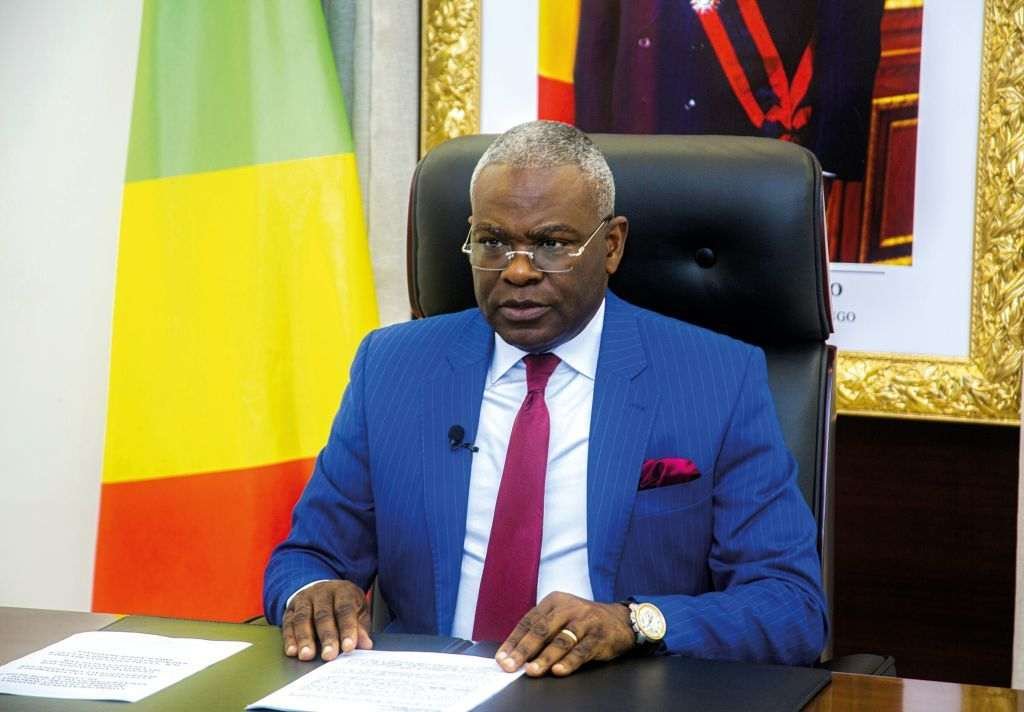
Interview with Anatole Collinet Makosso, Prime Minister, Head of Government, since May 12, 2021. Reappointed to head the Congolese government after the legislative elections in September 2022, he continues the consolidation of public finances.
Where are we in the implementation of the 12 battles, the government's action program?
Thank you for your interest in the actions of the Government of the Republic of Congo. On June 21, 2021, we presented to the members of parliament what everyone calls the "12 Battles," the government's Action Program. These 12 battles are a set of commitments made to implement the President of the Republic's vision for society, which has been translated into a national development plan. There are 82 of these commitments. 46 are considered achieved, 26 are in the process of being achieved, and 10 are not yet achieved simply because we are in the process of establishing the mechanisms that will allow us to launch their implementation. We have allocated five years to achieve our objectives. As you can see, this is a process. It remains to be seen how much our actions will impact society and the population, and that is the work that must continue.
You are said to be committed to good governance. What actions have you taken against corruption?
Against corruption, and therefore to establish good governance, we have adopted several texts, such as the constitution to remind us of our obligation to declare assets, for example, which imposes on us a certain number of attitudes to observe in the face of public affairs.
We have all the necessary oversight institutions. The Court of Auditors and Budgetary Discipline, whose law is currently being adopted, has been strengthened to enable this institution to properly fulfill its role. You have the Commission for Transparency in Public Finance Management. You have a number of decrees, including the strengthening of the law on corruption and the decree on the prevention of conflicts of interest. Remember, Congo, my country, adopted a decree in December 2022 to redefine the operating and organizational conditions of the procurement unit. You also have a decree, also adopted in 2022, defining the list of controls and inspections to prevent abusive oversight by state agents of private operators. In my opinion, we have a significant body of legislation and regulations, which can already serve as a deterrent and a means of enforcement.
We can also highlight that, starting January 1, 2024, the Republic of Congo will align itself with the best international standards in public financial governance through the implementation of program-based budgeting. This new practice should profoundly change public governance in our country by implementing a results-oriented management approach, which will undoubtedly contribute to making public action more effective in improving the well-being of the population.
What types of partnerships do you wish to develop with the private sector?
First, I am delighted to see the growing interest from the private sector – and especially from international players – in the Republic of Congo and its economy. This interest reflects the considerable efforts we have undertaken to make Congo more attractive. Under the leadership of the Head of State and with the crucial support of the government team, we have worked tirelessly to create an enabling environment for investment and to implement essential structural reforms. We have taken decisive steps to improve governance, strengthen the transparency and efficiency of our institutions, and implement responsible fiscal and economic policies. These actions have helped to build confidence among private and international actors in our country as an attractive investment destination. In collaboration with relevant stakeholders, we have established a robust framework to facilitate public-private partnerships and encourage investment in strategic sectors such as infrastructure, industry, and agriculture. We have worked on legislative and regulatory reforms to streamline procedures, expedite approvals, and ensure greater legal certainty for investors. These efforts have paid off, as evidenced by the public-private partnership agreements we have signed with internationally renowned companies such as Abu Dhabi Port and Arise IIP.
The agreement signed with Abu Dhabi Port for the establishment of a new multimodal quay at the autonomous port of Pointe-Noire, representing an investment of $500 million, demonstrates our commitment to developing quality infrastructure to facilitate trade and strengthen our position on the international stage.
The contract with the Lusis-Eco Global consortium for collecting property tax across the country is a significant step in mobilizing domestic resources. It demonstrates our commitment to strengthening our financial capacity to fund crucial development projects.
Finally, the arrival of Arise IIP in Congo with special economic zone development projects in Pointe-Noire and Ouesso is a remarkable opportunity. These special economic zones will contribute to diversifying our economy, creating jobs, and attracting foreign investment, in line with our National Development Plan.
Another partnership is being developed with Arise IIP for the structuring of the Congolese poultry sector, with a view to reducing our imports and better meeting national demand.
These partnerships are essential for stimulating economic growth, mobilizing resources, and creating jobs. They also allow us to leverage private sector expertise, mobilize additional financial resources, and adopt international governance standards. More broadly, PPPs offer us the opportunity to unlock our country's economic potential by encouraging targeted and sustainable investments. Therefore, we strongly encourage private sector actors, both national and international, to continue engaging in partnerships with the Congolese government. We are committed to pursuing these efforts and thank all those who contribute to these initiatives. Together, we are building the future of our nation and working towards sustainable and inclusive development for all.
When do you expect to achieve the debt reduction targets of the Central African Economic and Monetary Community (CEMAC)?
If I understand your question correctly, it concerns meeting one of the convergence criteria defined within the CEMAC, which is to maintain a public debt ratio less than or equal to 701% of Gross Domestic Product (GDP)? In this regard, Congolese public debt management is currently guided by the medium-term debt management strategy, in accordance with Regulation No. 12/07-UEAC-186-CM-15 of March 19, 2007, adopted by the CEMAC countries. We would like to point out that, among the requirements of this regulation, is the obligation for member states to develop comprehensive guidelines for domestic and external public borrowing and debt management. These guidelines will then be used to determine a public debt strategy. It is within this framework that the government's action to meet the convergence criterion, which consists of maintaining a public debt ratio below 701,05 ...
Today, the medium-term budget framework for 2024-2026, presented by the government last August to the National Assembly, shows a trajectory for the public debt ratio geared towards achieving the target level set by the CEMAC (Economic and Monetary Community of Central Africa). Thus, the public debt ratio forecasts for 2023, 2024, 2025, and 2026 are 98.91%, 92.41%, 82.51%, and 73.71%, respectively. As you can see, the trend in the public debt ratio is downward for the coming years, reflecting the government's commitment to ensuring it aligns with community standards and providing the government with greater budgetary flexibility.